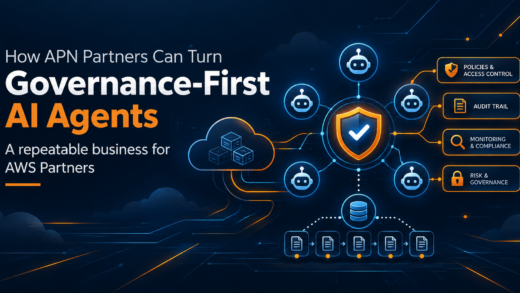
AI agents are moving from demonstrations into regulated business processes. For AWS Partners, that shift creates a larger opportunity than simply helping customers connect a model to a chatbot. The commercial value is in designing agents that can act within clear boundaries, explain their decisions, and fit existing governance, security, and compliance controls.
Fenergo’s work with Amazon Bedrock offers a useful blueprint. Rather than treating governance as a final review step, the approach makes it part of the agent’s design. That matters to resellers, managed service providers, independent software vendors, system integrators, and consultants serving financial services and other highly regulated industries.
Governance is becoming the product
Many customers are interested in AI agents that can investigate cases, collect information, summarize documents, recommend actions, and coordinate work across systems. Their main obstacle is rarely the model alone. It is confidence. Business and compliance leaders need to know what information an agent used, which tools it called, what it changed, and where a human remained accountable.
For APN Partners, this changes the conversation. An AI project should not be positioned only as an efficiency initiative. It should be packaged as a controlled operating capability with identity, permissions, monitoring, audit trails, testing, and human approval built in.
The Fenergo example is especially relevant because onboarding, know-your-customer, and anti-money-laundering workflows involve sensitive information, complex rules, and decisions that may need to be defended later. Partners can apply the same design principles to insurance, healthcare, public sector, tax, legal, and critical infrastructure use cases.
What Amazon Bedrock means for partner delivery
Amazon Bedrock gives partners a managed foundation for building generative AI applications and agents without operating model infrastructure directly. Its model choice, security, orchestration, and integration capabilities can help partners create repeatable architectures rather than one-off demonstrations.
The practical opportunity is to standardize a reference implementation. A partner could offer a governed agent package that includes a Bedrock-based orchestration layer, approved foundation models, retrieval from authorized enterprise data, tool access through explicitly defined actions, logging, evaluation, and escalation to a human reviewer.
This is more valuable than selling prompt engineering as a standalone service. Customers can measure a governed solution against operational outcomes such as shorter case-review cycles, fewer manual handoffs, improved documentation quality, and more consistent analyst decisions.
Four actions partners should take now
1. Define the agent’s authority before its features
Start each engagement by documenting what the agent may read, recommend, and execute. Separate low-risk activities, such as summarization, from higher-risk actions, such as changing a customer record or approving a case.
Use least-privilege access and make permissions specific to the user, role, workflow, and data involved. A clear authority model helps consultants run better discovery workshops and gives MSPs concrete controls to monitor after launch.
2. Build evidence into every workflow
Regulated customers will ask how an outcome was produced. Partners should capture the relevant inputs, retrieved sources, tool calls, approvals, exceptions, and final actions. The goal is not to store every piece of internal model reasoning. It is to create a practical operational record that supports review, troubleshooting, and compliance reporting.
That evidence can become a managed service. Partners can offer dashboarding, alerting, retention policies, audit exports, and periodic control reviews alongside the agent itself.
3. Create a model and evaluation strategy
Different tasks may require different models, latency profiles, and cost points. Partners should define which models are approved for which workloads, how sensitive data is handled, and what happens when confidence is low or the output fails validation.
Pre-production testing should include representative cases, adversarial inputs, policy violations, incomplete records, and attempts to access unauthorized information. Repeatable evaluation assets can become a differentiator for ISVs and system integrators because they shorten future deployments and provide customers with measurable acceptance criteria.
4. Keep humans accountable for consequential decisions
Human review should be designed into the workflow, not added after an incident. An agent can prepare a case, identify missing evidence, and recommend next steps while a qualified employee retains authority over decisions that affect customers or regulatory obligations.
Partners should define escalation thresholds, reviewer responsibilities, override procedures, and service-level targets. This gives customers a safer path from assisted work to greater automation as evidence accumulates.
Where the partner opportunity is largest
Resellers can use governance-first architectures to move beyond license transactions and attach implementation, security, data, and support services. MSPs can operate the controls customers do not want to staff themselves, including monitoring, incident response, model updates, and access reviews.
ISVs can embed governed agent capabilities into existing compliance, onboarding, or case-management products. System integrators can build industry-specific accelerators that connect Bedrock to customer systems while preserving approval gates and auditability. Consultants can help executives establish AI policies and translate them into technical controls.
The strongest offerings will combine all of these elements into a repeatable commercial package: assessment, architecture, pilot, production deployment, managed operations, and continuous governance.
Turn the blueprint into a sellable offer
Begin with one narrow workflow where the customer already has measurable pain and reliable source data. Establish baseline performance, map the decision authority, and identify the controls required before selecting the agent’s actions.
Then create a short pilot with explicit success criteria. Examples include reducing manual review time, improving completeness of onboarding files, or routing exceptions more accurately. Price the pilot so it leads naturally to production hardening and an ongoing managed service.
Fenergo’s governance-first direction demonstrates an important market lesson for AWS Partners: customers do not need another impressive AI demo. They need an agent they can supervise, audit, secure, and operate in the real world. Partners that productize those capabilities will be better positioned to win regulated workloads and expand from projects into durable, recurring relationships.